Cuatro teorías y varias geometrías
Cruce. Madrid 2014
decargar pdf

Ogami Press en colaboración con Cruce presentaron en este proyecto expositivo mis últimos trabajos. Si con anterioridad mi labor se había caracterizado por la repetición obsesiva de elementos gráficos mínimos en estos nuevos trabajos el gesto, fundamental y característico en mis anteriores series, casi ha desaparecido por completo, y las obras se presentan casi en estado crudo, frias y distantes. Ausencia de toda gestualidad en favor del dibujo como herramienta cartográfica.

El resultado de esta simplificación son unos trabajos más apegados a lo físico, a lo concreto, a lo inmediato y al mismo tiempo -y paradójicamente- se trata de obras tremendamente abstractas y evocadoras.

Realizadas con diferentes procesos de estampación y transferencia (grabado, fotolitografía, frottage…) su intención es recuperar y apropiarse de la memoria y las huellas que otros artistas y otras actividades han dejado impresas en los espacios intervenidos. Una serie de sencillas acciones que revelan detalles de una orografía invisible a simple vista. Reflejos de una mirada que se recrea en lo insignificante, en lo inadvertido, en lo mínimo; aspectos que, sin embargo, delatan el paso del tiempo y los acontecimientos velados bajo capas de pintura que aparentemente lo borran todo. Micropaisajes e historias mínimas en los que perderse.

Four theories and several geometries
Cruce. Madrid 2014
decargar pdf

Ogami Press, in collaboration with Cruce, presented my most recent works in this exhibition project.

While my previous practice was characterized by the obsessive repetition of minimal graphic elements, in these new works, the gesture —so fundamental and distinctive in my earlier series— has almost completely disappeared. The pieces are presented in a raw state: cold and distant. A complete absence of gestural expression in favor of drawing as a cartographic tool.

The result of this simplification is a group of works more grounded in the physical, the concrete, the immediate —and yet, paradoxically, they are profoundly abstract and evocative.

Created through various printing and transfer processes (etching, photolithography, frottage…), their aim is to recover and appropriate the memory and traces left behind by other artists and past activities in the spaces intervened. A series of simple actions reveal details of an orography invisible to the naked eye —reflections of a gaze that lingers on the insignificant, the unnoticed, the minimal; elements that, nonetheless, betray the passage of time and the events concealed beneath layers of paint that seemingly erase everything. Microlandscapes and minimal stories in which to lose oneself.

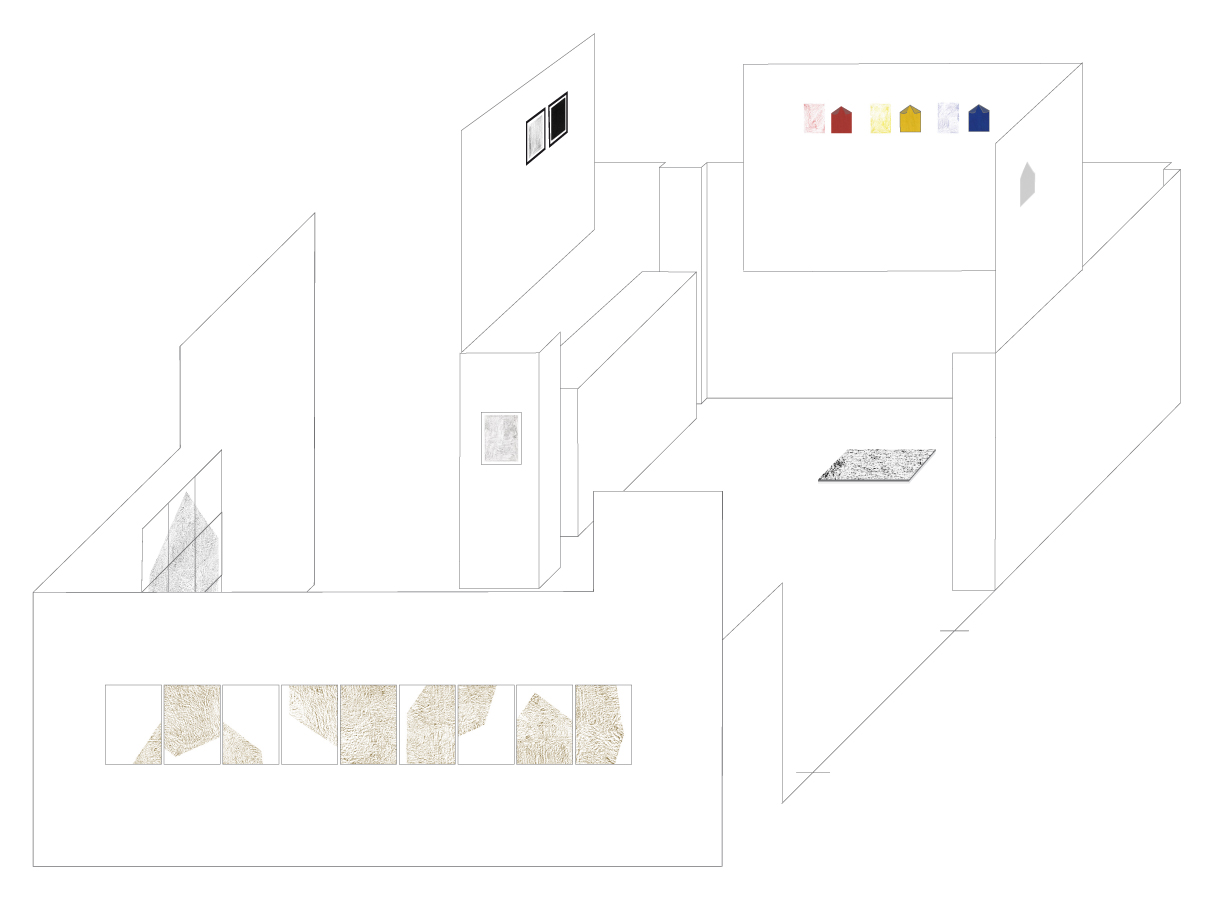
La pieza que me sirvió como punto de partida para desarrollar este proyecto fue Geometría para E.C. ( +info), una cartografía de un área delimitada del suelo del estudio/taller de grabado de Juan Lara (Ogami Press). Un espacio aparentemente neutro, cemento pulido para ser más concretos, que al ser intervenido ha revelado su propia geografía; las huellas que el tiempo y los diferentes usuarios del taller han dejado impresas en él. Del dibujo resultante se han editado dos series litográficas: una obra de tirada única en tinta negra, y una segunda serie en dorado con tirada de nueve ejemplares de la pieza completa.

Geometría dorada para E.C. (edición seriada de Geometria para E.C.) funciona como una especie de Tangran. Partiendo de la forma original, su figura puede componerse y recomponerse, formando nuevas y sorprendentes geometrías, combinando o permutando las diferentes piezas que la componen. Para la producción de Geometría para E.C. se han utilizado las planchas de poliéster y litográficas utilizadas en la producción de la obra como soporte para el papel ya impreso. Un montaje que a modo de sandwich contiene todas la huellas del proceso en diferentes capas, invisibles para el espectador al estar ocultas, pero latentes en todo caso.

El proyecto se completa con el díptico El sueño de una teoría final (+info) realizado durante mi última residencia en Landesatelier (Salzburgo) y una conjunto de intervenciones llevadas a cabo en el espacio de Cruce.

Se trata de una serie de frottages, Variaciones (+info),  con papel de calco de diferentes colores -incluidos el blanco cuyo rastro es invisible- que se conciben como obras en proceso, pues crecen y se degradan al sumar nuevas huellas y peder intensidad en cada nueva instalación; un grabado instalado sobre la propia huella que reproduce, y una pieza de suelo (Todos mis amigos me parece guapos +info) -presentada en esta ocasión apilada sobre una peana de metacrilato- que reproduce a escala 1/1 en pliegos de papel poliéster la totalidad del suelo de Cruce, concretamente 69,56 m2.


The piece that served as the starting point for developing this project was Geometry for E.C. ( +info),, a cartographic drawing of a defined area of the floor in Juan Lara’s printmaking studio (Ogami Press). A seemingly neutral space—polished concrete, to be precise—that, once intervened, revealed its own geography: the marks and traces left over time by the studio’s various users. From the resulting drawing, two lithographic editions were produced: one unique edition printed in black ink, and a second golden series with an edition of nine full pieces.

Golden Geometry for E.C. (a serialized edition of Geometry for E.C.) functions like a kind of Tangram. Starting from the original shape, the figure can be composed and recomposed, forming new and surprising geometries by combining or permutating its individual components. For the production of Geometry for E.C., both polyester and traditional lithographic plates used in the printmaking process were employed as the backing for the already printed paper. A layered «sandwich-like» assembly that contains all the process’s traces in different strata—invisible to the viewer, as they are hidden, but nevertheless latent.

The project is completed by the diptych The Dream of a Final Theory (+info), created during my last residency at Landesatelier (Salzburg), along with a series of interventions carried out at the Cruce space.

This includes a series of frottages titled Variations (+info),, made with different colors of carbon paper —including white, whose mark remains invisible— conceived as works in process, as they grow and fade with each new layer of impressions and lose intensity with each installation; a print installed directly over the trace it reproduces; and a floor piece (All My Friends Seem Handsome to Me +info) —presented here stacked on a methacrylate pedestal— which reproduces the entire floor of Cruce at 1:1 scale using sheets of polyester paper, totaling exactly 69.56 square meters.